


Best Re-Root Canal Treatment (Re-RCT) in Delhi (Dwarka)
Why your Root Canal failed and why Dr. Pankaj Rao is recognized as the best Re-RCT Specialist in Delhi, India.
There is nothing more frustrating than undergoing a Root Canal Treatment (RCT) only to find the pain returning months or even years later. For many patients searching for Re-Root Canal Treatment in Delhi (Dwarka), the fear of losing a tooth to extraction is real.
However, a “failed” root canal isn’t the end of the road—it is simply a signal that the initial treatment lacked the microscopic clarity required to navigate your tooth’s complex anatomy.
At Oraa Care Smile Dental Clinic, we specialize in Endodontic Retreatment (Re-RCT). Using a “Zero-Guesswork” protocol involving 3D CBCT imaging and 25X Surgical Microscopes, Dr. Pankaj Rao identifies the “invisible” causes of failure and restores your tooth to health, avoiding the need for expensive implants.
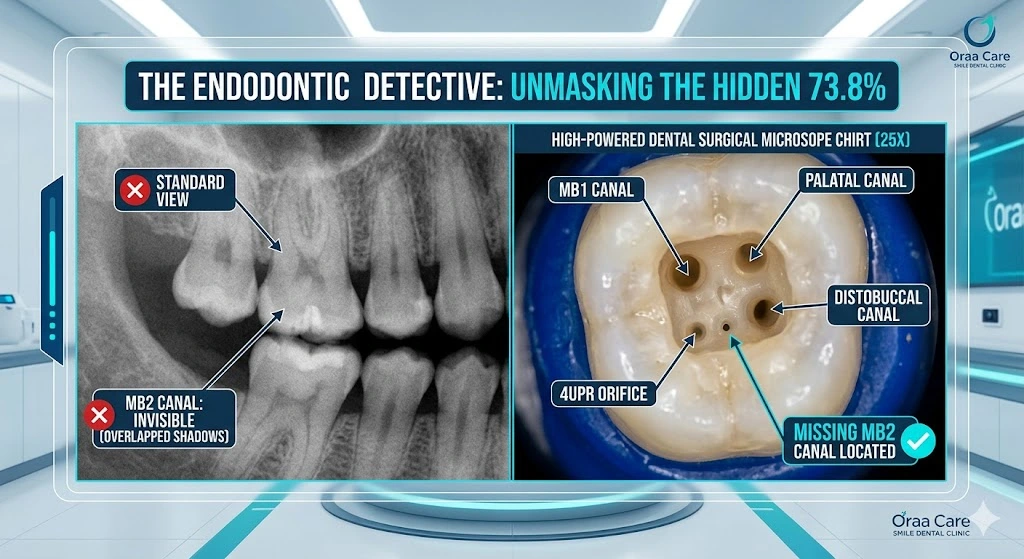
The Anatomy of Failure—Why 73.8% of Missed Canals Lead to Re-RCT
Why is Re-RCT Required?
To understand why you need Re-RCT, you must first understand why the initial treatment failed. Most general dentists perform RCTs using the naked eye or low-power magnification. While this works for simple cases, it often misses the “hidden” complexities of human anatomy.
The Elusive MB2 Canal
Clinical data shows that the MB2 (Mesiobuccal 2) canal is present in nearly 73.8% of upper molars, yet it is frequently missed in traditional 2D X-ray guided treatments. When a canal is left “untreated,” it becomes a sanctuary for bacteria. Over time, this leads to:
- Persistent, dull aching.
- Sensitivity to pressure or heat.
- The formation of a dental abscess or “pimple” on the gums.
Dr. Pankaj Rao’s Specialist Approach: As an IBDE Certified Endodontist, Dr. Rao doesn’t just “clean” the tooth; he explores it. Using 25X magnification, he locates these hidden canals that are invisible to 2D shadows, ensuring the source of the infection is finally eradicated.
73.8%
The “Hidden” Reality
Finding the Hidden 73%: Why 3D Precision is Critical
In traditional 2D dentistry, the MB2 canal is a ghost—present in nearly 74% of cases but visible in only 8% of standard X-rays. This “hidden canal” is a primary cause of root canal failure.
As an Endodontic “Detective,” Dr. Pankaj Rao utilizes 25X Surgical Microscopy and 3D CBCT imaging to navigate these anatomical mazes. We don’t just treat what we see; we find what others miss.
The “Failure Audit”: About Why RCTs Actually Fail
Other Reasons
Patients often mistakenly believe a failed root canal is a result of their own hygiene. It is critical to shift this narrative: a failure is rarely about the patient; it is about the limitations of the original diagnostic process.
-
Coronal Microleakage: Think of your tooth like a fortress. Even if the internal chambers (the canals) were cleaned perfectly, if the crown or filling above is loose or leaky, bacteria—which are smaller than a human cell—will infiltrate the area. This “microleakage” effectively re-infects the entire root canal system, turning a successful procedure into a recurring problem.
-
Vertical Root Fractures: Structural failure often stems from excessive forces, such as chronic grinding (bruxism), or occasionally, “over-cutting” during the initial RCT. When the dentin walls are thinned beyond their structural integrity, a hairline fracture occurs—an issue that is frequently missed without high-magnification vision.
-
The “Anatomy Trap”: Besides the MB2 canal, many patients deal with calcified canals. In a defense mechanism, the tooth may fill its own canals with dentin over time, making them nearly impossible to navigate with standard hand files. These are not “errors” by previous dentists, but biological complexities that require 3D CBCT mapping and microscopic navigation to overcome.
The “Zero-Guesswork” Technology—Your Protection During Re-RCT
1. The Diagnostic Reset
We map your root system with 3D CBCT, identifying the exact obstruction or missed canal that caused your initial failure.
2. Micro-Guided Cleaning
Under 25X magnification, we remove old materials with ultrasonic precision, ensuring zero damage to your healthy tooth structure.
3. Bio-Ceramic Seal
We use bioactive materials that actually bond with the tooth, creating a leak-proof barrier against future bacterial entry.
Zero-Guesswork
When it comes to Re-RCT in Delhi, the tools define the outcome. At Oraa Care, we have invested in a specialized digital suite designed specifically to turn “Unsaveable” cases into clinical successes.
-
3D CBCT: The 360° Diagnostic Roadmap
Traditional 2D X-rays are “shadowgraphs”—they overlap bone and tooth structure, often hiding the very infection causing your pain.
- The Re-RCT Benefit: Our 3D CBCT (Cone Beam Computed Tomography) allows Dr. Pankaj to see your tooth in three dimensions. We can identify exactly where a previous filling is leaking or where a root has a microscopic fracture. This allows us to plan the entire retreatment before we even touch your tooth.
-
The Surgical Microscope: 25X Precision
Working inside a root canal is like working inside a dark, microscopic tunnel.
- The Patient Perspective: Imagine trying to find a needle in a dark room. Now imagine doing it with a high-powered floodlight and a magnifying lens. The microscope allows Dr. Rao to remove old filling materials (Gutta-percha), navigate around broken instruments, and seal the tooth with micron-level accuracy. This level of vision is why our Re-RCT in Delhi has such a high success rate.
-
Woodpecker Ultrasonic Piezo Scaler (UDS-J)
Standard drills can be aggressive. For Re-RCT, we use Ultrasonic Piezo technology.
- The Benefit: These vibrations allow for the gentle removal of old cement and obstructions without damaging the healthy tooth structure. It is safer, quieter, and significantly more comfortable for the patient.
The Psychological Journey
From Frustration to “Aesthetic Certainty”
As a patient, a failed RCT can feel like a betrayal of trust. You’ve already spent time and money, and now you’re told you might need an extraction.
We understand the “Clinical Trauma” of a failed procedure.
Our Re-RCT process is designed to be a “Quiet & Calm” experience. By using advanced anesthesia protocols and the gentle precision of the microscope, we remove the “fear factor” of the dental chair. We don’t just treat the tooth; we treat the patient’s anxiety by providing Visual Transparency. We show you your 3D scans and microscopic images so you can see exactly why the first treatment failed and how we are fixing it.
Comparison: Standard RCT vs. Specialist Re-RCT at Oraa Care Smile Dental Clinic
A patient visited us with a “hopeless” lower molar that had undergone two failed root canals elsewhere. Using our 25X Micro-Precision Protocol, Dr. Rao identified a calcified canal that was completely invisible on previous 2D X-rays. After a single Specialist Re-RCT session, the patient was pain-free, and follow-up 3D scans confirmed complete bone healing at the 6-month mark. We don’t just treat teeth; we restore their longevity.
The “Clinical Timeline”
Expectations Management
We believe in “Zero Guesswork,” and that includes the timeline of your care.
-
Treatment Duration: A standard RCT may take 1-2 sessions. A Specialist Re-RCT is a more profound clinical investment, typically spanning 2-3 sessions (60–90 minutes each). This extended time is required to safely remove old materials and meticulously disinfect complex, calcified, or curved anatomy.
-
The “Healing Window”: Bone regrowth is a slow, silent, biological process. We don’t just finish the treatment and send you away; we implement a 6-month check-up protocol. You will return for a follow-up CBCT scan, where we will visually document the shrinkage of the infection and the regeneration of healthy bone around your tooth root.
The “Recovery Protocol”: A Calm Path Forward
Healing
Fear of the “second time” is a natural human response. We demystify the experience to ensure your peace of mind.
-
The First 48 Hours: Mild tenderness is a sign that the body is resetting its inflammatory cycle. It is part of the healing, not a sign of failure. We strongly advise a “No-Chew” zone on the treated tooth for 72 hours to allow the internal materials to set perfectly.
-
The “Bite” Check: A temporary filling that feels even slightly “high” can create significant, unnecessary pain. If your bite feels off, do not wait for it to “settle”—call us immediately for a precise, two-minute adjustment.
-
Proactive Maintenance: The Re-RCT done by an expert is the biological “reset.” For the longivity of the treated tooth, a custom-made crown or overlay is non-negotiable. It acts as the final, airtight seal that protects your investment and your natural tooth from future microleakage.
Why Choose Dr. Pankaj Rao for Re-RCT in Delhi?
Why Dr. Pankaj Rao?
Choosing the right specialist for Re-RCT in Delhi is the difference between keeping your natural tooth for life or losing it to an implant.
- Elite Credentials: Dr. Pankaj Rao is a Diplomate of the Indian Board of Endodontists—a title held by only a small percentage of specialists in India.
- Specialization in “Failed Cases”: While many clinics refer complex cases out, we are the referral center where other dentists send their “impossible” root canals.
- Bio-Ceramic Sealing: We use the latest Bio-Ceramic sealers that are biocompatible and encourage the bone to heal around the root, ensuring your Re-RCT is a permanent solution.
Don’t Let a Failed Root Canal Lead to an Extraction
Your natural tooth is superior to any artificial implant. If you are experiencing pain in a previously treated tooth, don’t wait until the infection spreads. Experience the “Zero-Guesswork” precision of microscopic Re-RCT in Delhi (Dwarka) at Oraa Care Smile Dental Clinic
Re-Root Canal Therapy: Essential Patient FAQs
FAQs
In almost every clinical scenario, a well-performed Re-Root Canal is superior. Your natural tooth root contains specialized ligaments that provide sensory feedback and act as a natural shock absorber. We aim to save your original tooth whenever the structural foundation allows, keeping your smile 100% natural.
No. A “failed” root canal is an active infection site. Delaying treatment allows bacteria to spread through the root apex into your surrounding jawbone, causing bone loss. Early intervention makes Re-RCT a 95% predictable success; waiting until swelling or an abscess appears significantly compromises the prognosis of the tooth.
Re-RCT is more complex because it involves navigating legacy materials and procedural variables from the first attempt. However, when performed by a specialist using 25X Surgical Microscopy and 3D CBCT imaging, success rates at Oraa Care often exceed 90%. We don’t guess—we visualize and seal the anatomical complexities that caused the original failure.
Retreatment is an “Endodontic Challenge.” It requires the removal of hardened legacy filling materials, management of potential canal blockages, and navigation of complex anatomy. General dentists focus on a wide variety of dental needs; specialists possess the specific equipment and the daily volume of complex cases required to master these microscopic variables.
Yes. To guarantee the success of your retreatment, the tooth must be “sealed from the top down.” Because we often have to access the canals through the existing crown, a new, perfectly fitted crown is the most important clinical safeguard against future coronal microleakage, which is the leading cause of root canal failure.